
“1000th Anniversary of the Coronation of Boleslaus the Brave”
Narodowy Bank Polski is putting into circulation a new collector banknote, with a face value of 20 złoty.
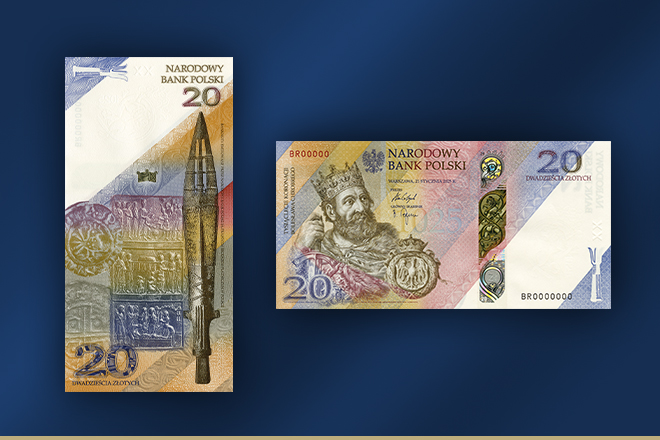
Narodowy Bank Polski has announced that a collector banknote “1000th Anniversary of the Coronation of Boleslaus the Brave” will be available for sale as of tomorrow, 5 November 2025.
The banknote commemorates one of the most important moments in the history of Polish statehood. This is another issue referring to the millennium of the coronation – Narodowy Bank Polski previously commemorated this event with collector coins.
The banknote with a face value of 20 złoty has the dimensions of 170 x 85 millimetres. It has been minted in up to 70,000 pieces. The banknotes are sold at all the NBP regional branches and in the NBP online shop Kolekcjoner at the price of PLN 160.
The front side of the banknote depicts an image of Boleslaus the Brave according to the print by Rudolf Fryderyk Friedlein from ca. 1857, which was inspired by the portrait of the King by Marcello Bacciarelli. Next to the image, there is a decorative security stripe in gold and silver, with a print featuring a fragment of the bordure of the Gniezno Doors and the banknote’s denomination. The year 1025 is placed in the centre of the banknote as one of its security features visible in ultraviolet light. In the bottom right corner, there is a recto-verso security feature depicting a stylised fragment of the tip of the Lance of Nętno.
The back side of the banknote, composed in a vertical arrangement, features, among others, the images of three panels of the Gniezno Doors and the observe and reverse of Princes Polonie, a coin from the reign of Boleslaus the Brave, as well as the tip of the Lance of Saint Maurice. Scenes from the Gniezno Doors and the coin’s obverse can be seen in ultraviolet light. This side of the banknote also features a crown-shaped window cut into the paper, inside which one can see a gold fragment of the security stripe of the banknote’s front side. In the transmitted light, the window is seen in blue. The banknote paper bears a watermark depicting the image of a fragment of the bordure of the Gniezno Doors and the notation of the coronation year of Boleslaus the Brave. The microtexts on the front and back side of the banknote feature an epitaph from the king’s sarcophagus reading Inclyte dux tibi laus strenue Boleslae / Respected leader, glory be to you, brave Boleslaus.
The coronation of Boleslaus the Brave in 1025 was one of the most momentous events in a string of other similar ones that the ruler’s reign abounded in. It was the duke’s activity that led to the foundation of the Archbishopric of Gniezno in 1000, which was then equivalent to the emancipation and strengthening of the power of the state, besides the mere religious significance of the event.
This was possible thanks to the Polish ruler’s support for the mission to pagan Prussians led by the bishop of Prague Wojciech Sławnikowic, later to become the patron saint of Poland, Saint Adalbert, and then buying the martyr’s body back in exchange for an amount of gold – as legend has it – equal to its weight. Of great importance to the whole affair was the close alliance or even friendship between the Polish ruler and Holy Roman Emperor Otto III, which opened the way to the subsequent coronation of Boleslaus the Brave.
Around 1000 Boleslaus ordered the mintage of a coin known as the Princes Polonie denarius, on which the Latin name of the country appeared for the first time, thus manifesting the existence of a political organism of importance equal to other countries of established Christianity. The advance of Christianisation, along with the foundation of the archbishopric, provided the inhabitants protection against being traded as slaves.
The hard and prolonged wars with King of Germany Henry II, won by Boleslaus the Brave, had given the newly forming community a sense of success and the winner ethos, which later on proved to be of significance in difficult times. The coronation of Boleslaus the Brave coping his excellent reign infused the historical memory of the emerging Polish community with the belief that they were on a par with the leading nations of Christian Europe. Over the centuries, the memory of this event strengthened the morale of the Polish community, and during the partitions period it kept alive the ideas of independence and empowerment in the subsequent generations of Poles.
More information can be found in the brochure.