
“5 złoty from the Period of the November Uprising”
Narodowy Bank Polski is putting into circulation silver coins of the series “History of the Polish Coin”.
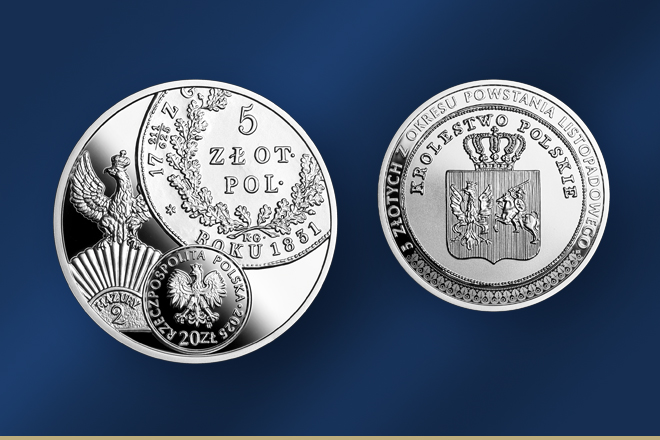
Narodowy Bank Polski has announced that silver collector coins of the series “History of the Polish Coin” – “5 złoty from the Period of the November Uprising” will be available on sale as of tomorrow.
The coin with a face value of 20 złoty is made of 925 purity silver, has a diameter of 38.61 millimetres and weighs 28.28 grams. It has been minted in up to 10,000 pieces. The coins are sold at all the NBP regional branches and in the NBP online shop Kolekcjoner at the price of PLN 420.
The obverse of the new NBP coin features the reverse of the 5-złoty coin from 1831 and the eagle from the cap of an officer of the 2nd Masovian Cavalry Regiment. The reverse is distinguished by the original obverse side of the insurgent 5-złoty coin. It features a two-field crowned escutcheon with the Eagle and the Chase, and the legend: KRÓLESTWO POLSKIE (Kingdom of Poland). The theme of the new coin is additionally emphasised by the inscription in the ring along the rim: 5 ZŁOTYCH Z OKRESU POWSTANIA LISTOPADOWEGO (5 złoty from the period of the November Uprising). There is also an ornament at the bottom taken from a commemorative box with a set of insurrection coins.
During the November Uprising (29 November 1830 – 7 September 1831), the Warsaw Mint operated at full capacity under difficult conditions. The Polish National Government demanded as much money as possible to cover its enormous expenses.
As a result, during certain periods, the mint worked around the clock, and its employees “do not go home, but rest on straw in turns”. An additional problem was the installation of a cannon factory in the mint building, which also used the equipment there. To make matters worse, some employees were forcibly conscripted into the insurgent army, and there was a threat of even greater conscription.
Another problem was the lack of raw materials for coin production. Attempts were made to remedy this by confiscating silver and gold items from temples of all faiths. Church bells were used to obtain raw materials for minting copper 3-grosz (trojak) coins.
Despite the outbreak of the uprising, the mint initially continued to strike coins using the old stamps. The change did not take place until after the dethronement of Nicholas I on 25 January 1831. As early as on 10 February, the mint was ordered to remove the tsar’s portrait from the dies and replace it with a new coat of arms of the Kingdom, depicting the Eagle and the Chase on a divided, crowned escutcheon. Copper 3-grosz (trojak) coins, billon 10-grosz coins, silver 2-złoty and 5-złoty coins, and gold ducats of the Dutch type were struck with this new emblem. A total of 7.5 million coins of all types were minted.
More information can be found in the brochure.
NBP collector coins and banknotes are sold in commercial packaging with an attached certificate.
The next issue is scheduled on 9 December 2025. On that day Narodowy Bank Polski will be putting into circulation a silver coin of the series “Treasures of the Medal-Making Art” – “Michał Ossowski”, with a face value of 50 złoty.
Contact:
Contact for collectors: e-mail kolekcjoner@nbp.pl, tel. +48 22 185 17 05
Contact for the media: e-mail press@nbp.pl, tel. +48 22 185 2012
***
About NBP
Narodowy Bank Polski holds the exclusive right to issue banknotes and coins in Poland. All currency issued by NBP, including collector banknotes and coins, is legal tender in Poland. Issuing collector items is an occasion to commemorate historic figures and anniversaries as well as to develop the interest of the public in Polish culture, science and tradition.
High-resolution images of the coins: https://nbp.pl/en/coins-and-banknotes/collector-coins/catalogue/